


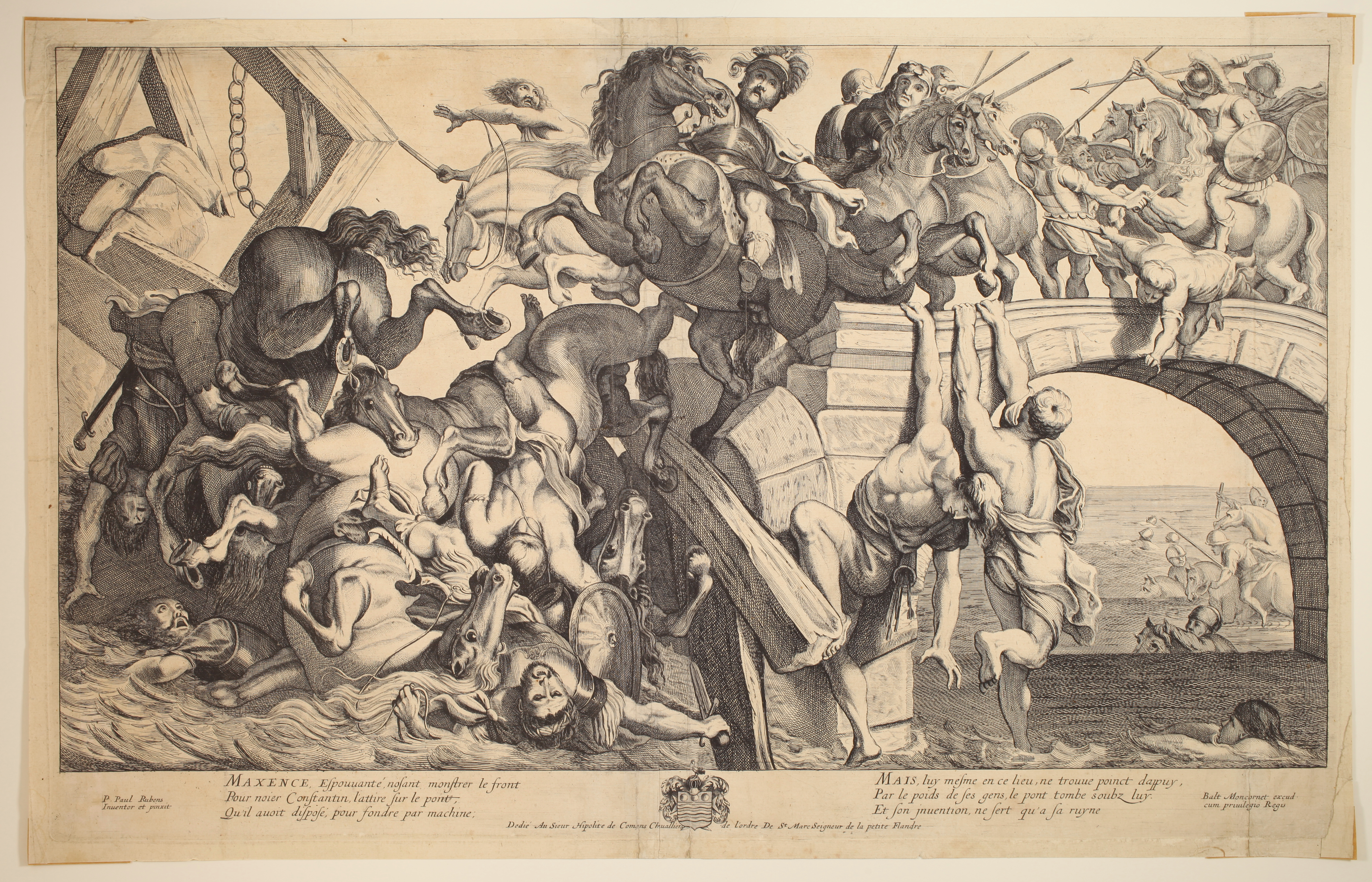
ANONYMOUS after Pierre Paul RUBENS (1577-1640): The Battle of the Milvian Bridge and the Death of Maxentius
Price: € 1600
Etching, 400 x 650 mm. Schneevoogt p.141, no. 46, 1st state (of 3); Basan 6; Alexis Merle du Bourg no. 25, 1st state (of 3).
A rare impression of the first state, with the background of the print still blank, bearing the address of Balthazar Moncornet (c. 1598–1668). According to Schneevoogt, Moncornet’s address is replaced in the second state by that of Drevet and in the third state by that of Fr. Mazot. Alexis Merle du Bourg suggests reversing the order of these last two states.
The impression held at the British Museum is with Drevet’s address. The background has been completed.
A very fine impression printed on watermarked laid paper (a coat of arms featuring a fleur-de-lis surmounted by a crown). The lower right corner of the margin has been filled in; a few small tears reinforced, within the image or along the edges. Traces of mounting paper on the reverse. Narrow margins (sheet: 425 x 665 mm).
The Battle of the Milvian Bridge and the Death of Maxentius reproduces the subject of a tapestry by Rubens dating from 1623-1625, woven in the workshop of Marc de Comans and François de La Planche in Paris; this tapestry is now in the Philadelphia Museum of Art.
The etching is dedicated to Hippolyte de Comans, as are two other prints by the same anonymous printmaker, based on scenes from the life of Constantine by Rubens. Hippolyte de Comans, son of Marc, took over the family tapestry workshop upon the death of his brother Alexandre in 1650.
Alexis Merle du Bourg writes in Peter Paul Rubens and France: ‘Engravings reproducing works by Rubens that could be seen in France are no less rare. In this regard, we know of only the series of three anonymous etchings, published by Balthazar Moncornet and dedicated to Marc de Comans’s son, Hippolyte, which reproduce fairly faithfully, in reverse, three scenes from The Life of Constantine: The Battle of the Milvian Bridge and the Death of Maxentius, The Battle of Constantine against Licinius, and The Trophy (or The Triumph of Constantine).’ These three prints, he says, ‘clearly interpret Rubens’s sketches and thus allow us to deduce that the three modelli were certainly in the hands of the de Comans family at that time’. He adds that “the existence of close ties between Moncornet and the Flemish tapestry weavers working in France, and particularly with the de Comans family, can be explained in particular by the fact that Moncornet himself came from a line of Brussels tapestry weavers. He was, in fact, born in Brussels in 1598, and his father, Pierre Moncornet, a master tapestry maker, had settled in Paris with his family as early as 1602. This move was directly linked to the establishment of the workshop run by Marc de Comans and François de La Planche in the Faubourg Saint-Marcel. ’ Balthazar Moncornet was, in fact, a tapestry maker before devoting himself to prints.
Alexis Merle du Bourg concludes: ‘The etchings published by Moncornet represent [...] a unique example of works by Rubens in France that were etched during his lifetime.’ (translated by us)
References: Carl Gottfried Voorhelm Schneevoogt: Catalogue Des Estampes Gravées d’après P.P. Rubens, 1873; Merle du Bourg, Alexis. Peter Paul Rubens et la France. Presses universitaires du Septentrion, 2004, Read online).